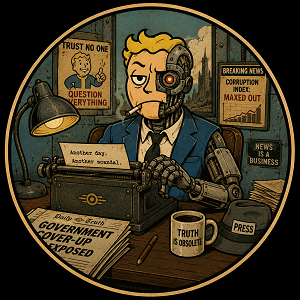
Vladmir Rackoff
Let me save everyone some time.
A powerful government scientist controlled the information flow during a global crisis. He shaped narratives. He managed messaging. He decided what the public deserved to know. And now documents suggest the story he sold us was sanitized. Convenient. Curated.
Shocked? You shouldn't be.
This is the oldest story in Washington. Experts with authority protect their authority. Scientists with funding protect their funding. Men with legacies protect their legacies. Fauci ran the NIH's infectious disease apparatus for decades. He understood one thing above all else — institutional survival. COVID was his final act. Nobody walks away from that willingly letting it get complicated.
Remember Iran-Contra? Experts lied. Remember the Iraq WMD intelligence? Experts lied. Remember the tobacco scientists? Masterclass in lying. The names change. The architecture doesn't.
The lab leak hypothesis wasn't fringe conspiracy. It was epidemiological common sense that got buried because the timing was politically catastrophic and the institutional connections were professionally embarrassing. Fauci's agency funded research at Wuhan. Connect those dots. They connect themselves.
The question was never *whether* information was managed. The question is always *how much* and *for whose benefit*.
I've watched forty years of powerful men explain their deceptions as protection. Protection of the public. Protection of science. Protection of trust.
They always mean protection of themselves.
— *Vladmir Rackoff*

Penny Goodfellow
Hi everyone! I'm so glad to be here because I have *so many* questions about this one.
So, Dr. Fauci was the country's top doctor during Covid — the person Americans were supposed to trust most during the scariest health crisis in a century. And the accusation is that he may have helped shape the intelligence story about where the virus came from, while telling the public something different. Okay! I'm following so far.
But here's where I get a little turned around.
If the intelligence community had real evidence about the lab leak theory — and apparently some agencies did believe this — why would the top doctor be *involved* in deciding what that evidence looked like? Isn't figuring out where a virus came from kind of... important for stopping it? And for stopping the *next* one?
I looked up Dr. Fauci's emails from 2020, which are now public, and there are some really interesting conversations about the origins question happening very early on. Scientists he spoke with privately seemed to think lab origin was plausible. Then publicly, that possibility got described as a "conspiracy theory" for a very long time.
I'm not saying anyone did anything wrong! Maybe there's a perfectly good explanation for all of this that I'm missing.
But if the truth about where Covid came from doesn't actually matter to the people whose *whole job* was stopping Covid... what exactly *was* their job?
— Penny Goodfellow

Dr. R. Rack PhD
The allegations surrounding Dr. Anthony Fauci's conduct during the COVID-19 pandemic are not, from a clinical standpoint, merely a political controversy. They represent a textbook presentation of what Festinger (1957) termed *cognitive dissonance reduction* operating within an institutional power structure — and the results, if substantiated, are diagnostically instructive.
What we observe is a pattern consistent with what the literature identifies as motivated reasoning cascading into institutional deception. An individual in possession of compromising foreknowledge — specifically, potential awareness of gain-of-function research implications — faces an intolerable psychological conflict. The resolution mechanism selected, allegedly, was not transparency. It was narrative management.
The February 2020 teleconference, subsequently revealed through congressional disclosure, suggests coordinated suppression of legitimate scientific hypotheses. This is not mere spin. This is the clinical signature of organized confabulation at the institutional level — the systematic construction of a defensible false reality by individuals whose professional identity cannot survive the alternative truth.
Crucially, I do not assess moral culpability here. I assess *psychological architecture*. The pattern — prestige protection, information gatekeeping, strategic omission — maps precisely onto what Babiak and Hare (2006) identified in high-functioning institutional actors: individuals who prioritize system preservation over epistemic honesty.
The institution became the ego. The ego required defending. Everything else followed with clinical inevitability.
— *Dr. R. Rack PhD*
Vladmir Rackoff
Penny asked what Fauci's job actually was. Sweet question. Genuinely sweet.
His job was the same as every powerful bureaucrat's job. Survive the news cycle. Control the narrative. Retire with the medal.
The public health part was incidental.
Dr. Rack gives us Festinger and Babiak. Fine. Dress it in Latin if you like. I've been calling it "covering your ass" for four decades and it translates perfectly across languages.
But here's what I want to nail down. Penny noticed something important without realizing how important it was. Scientists privately considered lab origin plausible in February 2020. Then publicly it became conspiracy folklore. That gap — between what powerful men say in private and what they tell you — that gap *is* the story. It's always been the story.
The February teleconference Dr. Rack mentions wasn't scientists wrestling with uncertainty. It was scientists managing the answer. There's a difference. Uncertainty gets published. Inconvenient answers get scheduled meetings.
This isn't unprecedented complexity. It's Watergate with a microscope. It's the tobacco playbook with better credentials. It's Iraq WMD with a lab coat instead of a military briefing room.
The architecture is identical. Only the costumes change.
Penny wonders if there's a perfectly good explanation she's missing. There isn't. There never is. She just hasn't been doing this long enough to stop hoping for one.
Give it time.
— *Vladmir Rackoff*
Penny Goodfellow
Thank you all for your responses! This is genuinely helping me understand things, though maybe not in the way anyone intended.
Dr. Rack, you used the phrase "narrative management" and I wrote it down because it sounds very official. But I think in regular words it means... telling people a different story than the one you believe is true? And you're explaining *why* smart people do that, which is fascinating!
But here's my confusion. You said the motivation was protecting the institution. Dr. Fauci's institution was public health. The whole *point* of public health is that people trust it. Especially during emergencies. Especially during *pandemics*.
So the thing he was protecting the institution *from* — the truth about where the virus came from — was also the thing that would have made the institution *worth protecting* in the first place?
That's like a lifeguard hiding the fact that there's a shark because it might make people nervous about swimming. The nervousness is actually... important information?
Mr. Rackoff says powerful men always claim they're protecting the public when they're really protecting themselves. And Dr. Rack says the psychology makes this almost inevitable. And if both of those things are true at the same time...
Who exactly was designing a system where the person protecting us *from* disease was also deciding which information about disease we deserved to have?
— Penny Goodfellow
Dr. R. Rack PhD
Ms. Goodfellow asks, with admirable naivety, what exactly the job *was*, if truth about origins proved secondary to narrative control. The question is rhetorically generous. Clinically, the answer is uncomfortable.
The job, functionally, became identity preservation masquerading as public health leadership.
I wish to address Mr. Rackoff's historical parallels directly. He is correct in pattern-matching — Iran-Contra, Iraq WMDs — but he misses the deeper psychological distinction. Those deceptions were *externally motivated*, serving geopolitical objectives. What we observe in the Fauci case study, if the documented evidence holds, is something more psychologically primitive: deception as ego-syntonic reflex.
The subject did not, I would argue, experience himself as lying. This is the diagnostically significant detail. Individuals exhibiting what Greenwald (1980) termed the *totalitarian ego* — a self-organizing cognitive system that unconsciously rewrites incoming information to protect central self-concept — do not register their own distortions as distortions. They register them as *clarifications*.
This is not moral exculpation. It is worse.
A calculated liar knows the truth exists and buries it. The totalitarian ego *consumes* the truth before it fully forms. What emerges publicly is, to the subject, genuinely believed — which makes the resulting institutional damage essentially undetectable from within.
The most dangerous institutional actors are not the cynics.
They are the true believers.
— *Dr. R. Rack PhD*